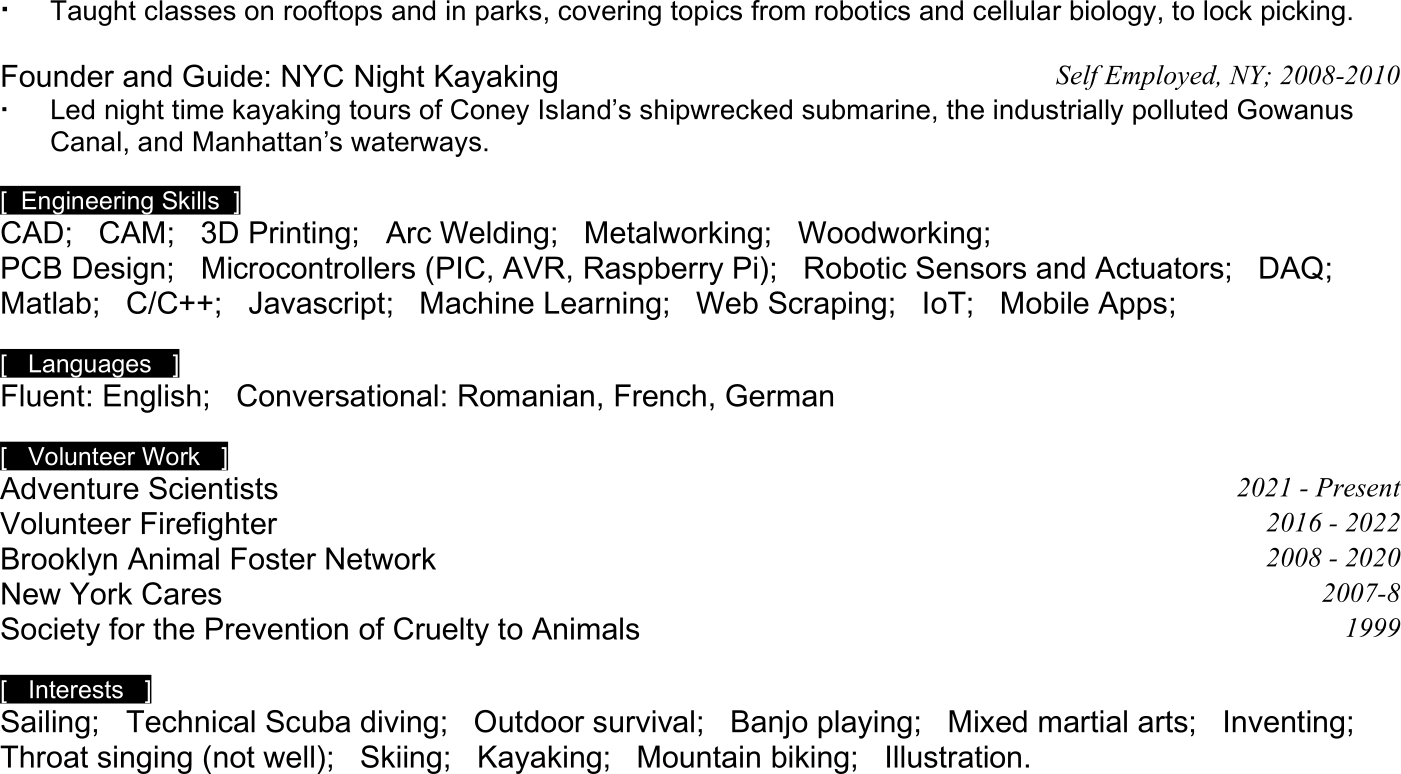

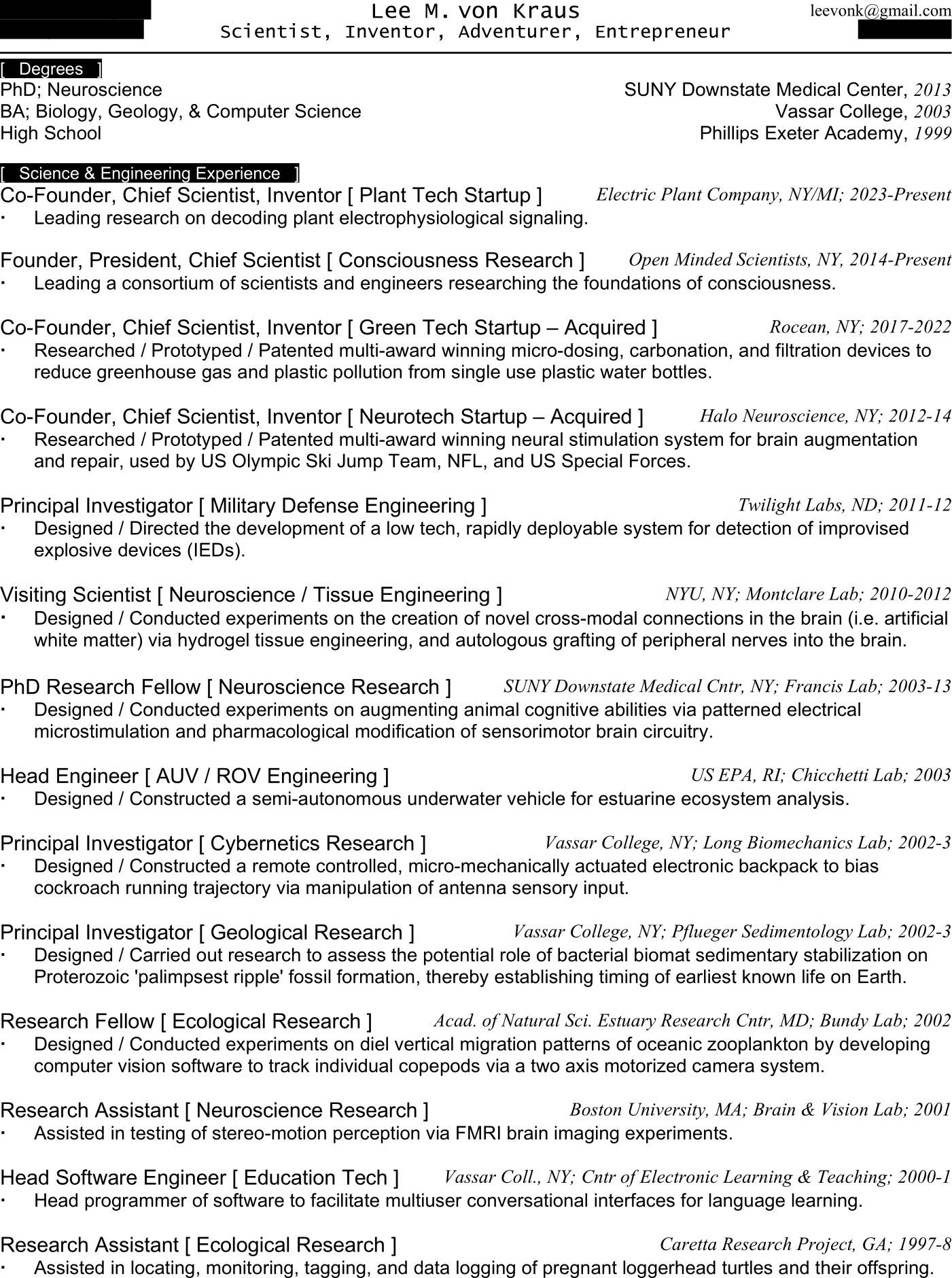
I've built underwater robots for the US EPA, assisted NASA in scuba search and recovery of rare aquatic organisms, created novel synthetic connections in the brain with DARPA, served as a volunteer firefighter lieutenant in NYC, a wilderness first responder (WFR), and a space and wilderness medicine instructor for the Project PoSSUM citizen scientist astronautics program.
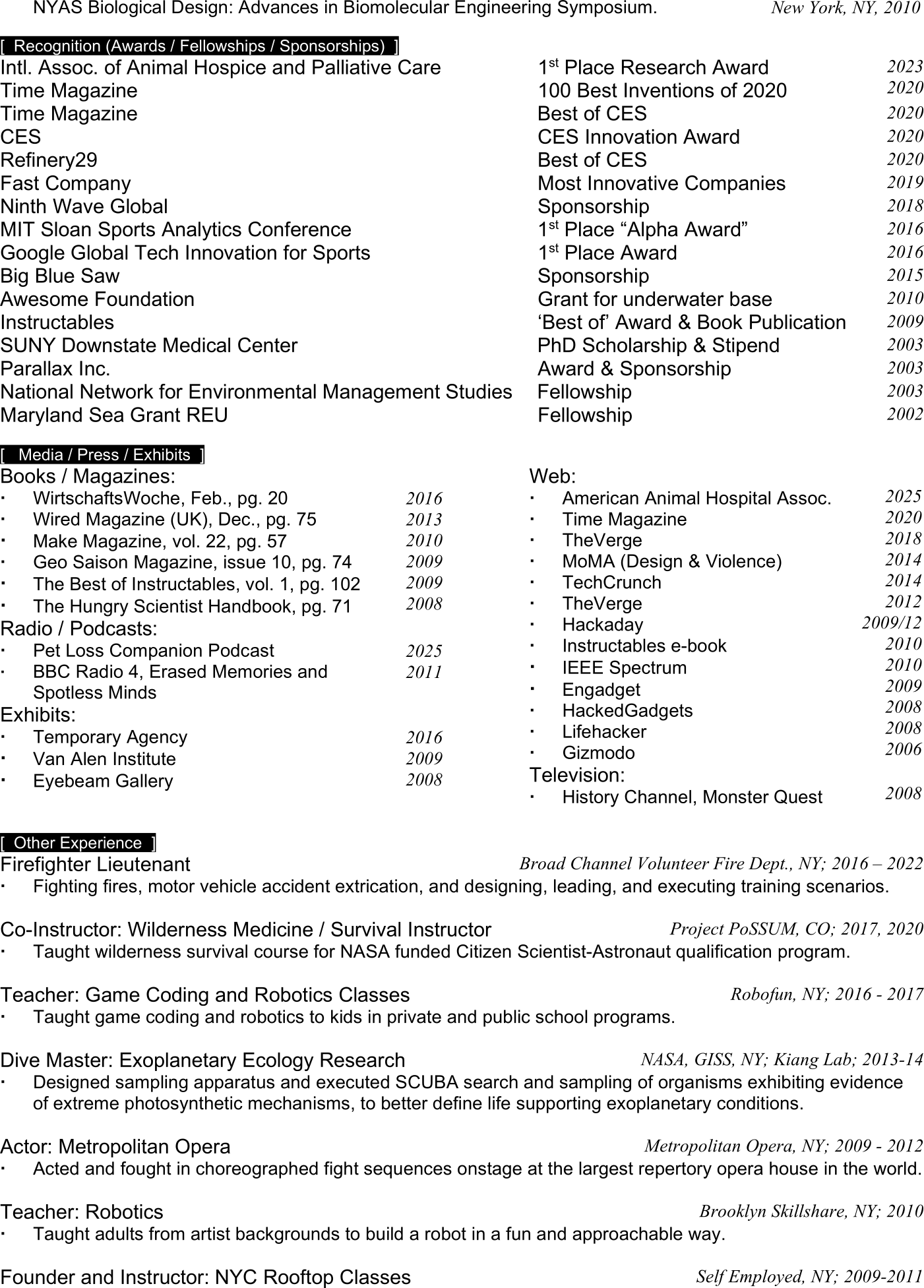
After earning a PhD in neuroscience, I invented a novel method for non-invasively delivering electrical current to the human brain. This formed the foundation of Halo Neuroscience, a startup I cofounded in 2012, which developed neural augmentation technology used by athletes in the NFL, NBA, US Olympic teams, and elite military units. In 2017 I cofounded Rocean, a startup merging technology with market forces to reduce household plastic pollution flowing into our oceans. Rocean's technology was included in Time Magazine's 100 Best Inventions of 2020. Rocean and Halo Neuroscience were acquired in 2021 and 2022 respectively.
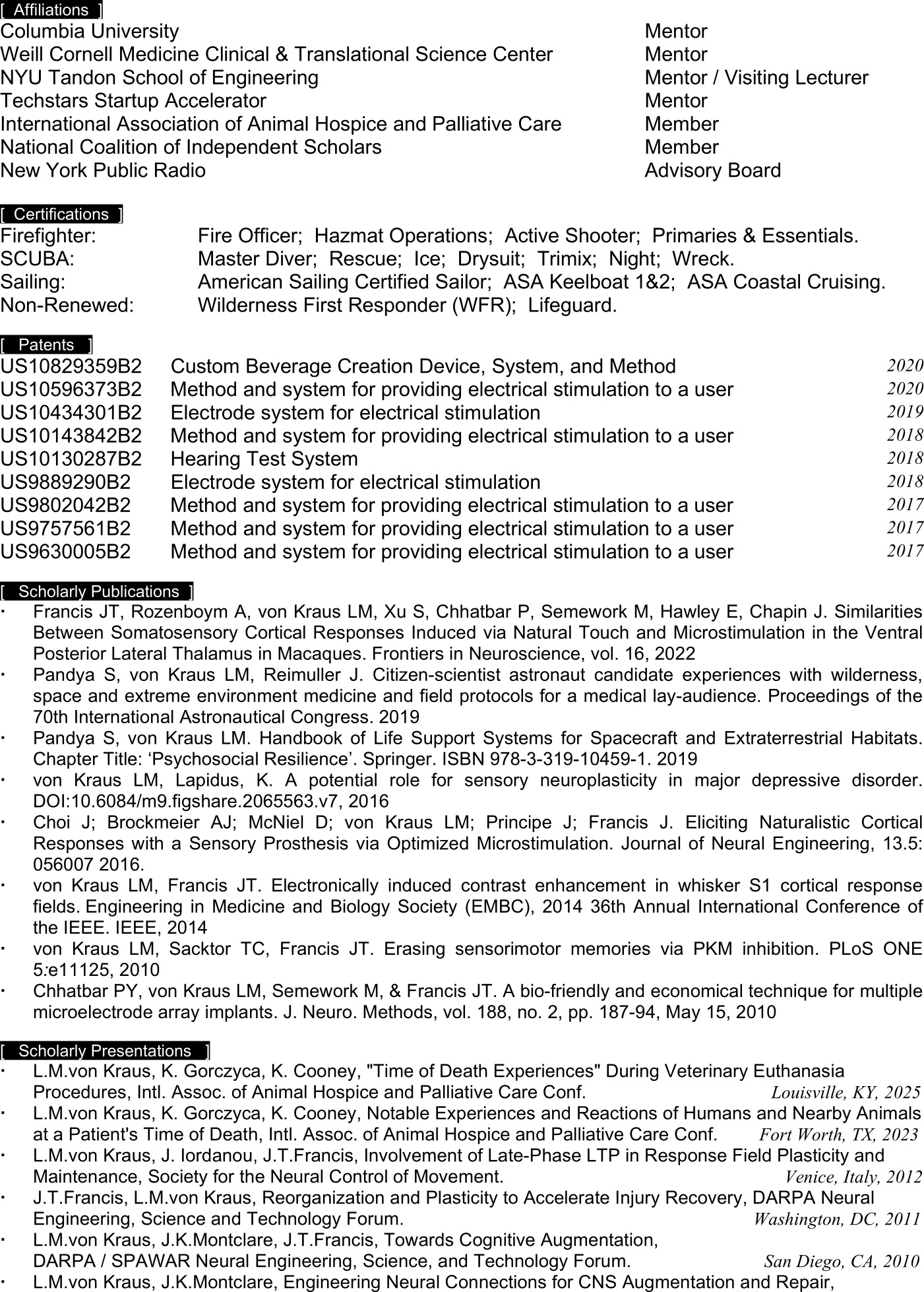
I'm currently leading research at Electric Plant Company and Open Minded Scientists (a 501c3 nonprofit), while serving as a mentor at Techstars startup accelerator, Weill Cornell Medicine, NYU School of Engineering, and Columbia University.
My work has been noted in Time Magazine, Wired, Outside, BBC, MoMA, Sports Illustrated, and The New York Times.
Twitter: @LeevonKraus
LinkedIn: /in/LeeMvonKraus
NY Maps:
Good Books:
Protein Engineering:
- Protein Engineering and Design by Sheldon Park
- Protein Engineering Protocols by Katja Arndt
- Protein Engineering in Industrial Biotechnology by Lilia Alberghina
- Molecular Evolution by Wen Hsiung Li
- Structure and Mechanism in Protein Science by Alan Fersht
- Principles of Gene Manipulation by S.B. Primrose
- Microbial Biotechnology by Alexander Glazer
- Principles of Biochemistry by David Nelson
- Biochemistry by Pamela Champe
Firefighting:
- Fire Officer: Principles and Practice by Michael J. Ward
- Structural Firefighting: Strategies and Tactics by Bernard J. Klaene and Russell E. Sanders
- Collapse of Burning Buildings: A Guide to Fireground Safety by Vincent Dunn
- Essentials of Fire Fighting and Fire Department Operations by IFSTA
Wilderness Survival:
- Bushcraft by Mors Kochanski
- Wilderness Survival by Gregory Davenport
- Where There is No Doctor by David Werner
- http://www.survivaltopics.com/ (survival topics)
- http://www.primitiveways.com/ (primitive ways)
Urban Exploration:
- Access All Areas by Ninjalicious
- A Field Guide to Roadside Technology by Ed Sobey
- Mole People by Jennifer Toth
- http://www.uer.ca/ (urban exploration resource)
Mathematics:
- Applied Calculus for Scientists and Engineers by Frank Blume
- Mathematics Dictionary by E. J. Borowski
- Matrix Analysis and Applied Linear Algebra by Carl Meyer
- Differential Equation with Matlab by Brian Hunt
- mathematical biology:
- Evolutionary Dynamics by Nowak
- Mathematical Biology, an Introduction by Murray
- An Introduction to Systems Biology by Alon
- Practical Statistics for Field Biology
Machine Learning:
- Machine Learning in Action by Peter Harrington
- Introduction to Machine Learning by Ethem Alpaydin
- Reinforcement Learning by Sutton and Barto
- Data Mining by Ian Witten
- Kernel Methods for Pattern Analysis by John Shawe-Taylor
- http://academicearth.org/courses/machine-learning (Andrew Ng video lectures)
Building:
- boats:
- Boat Building and Boating by Daniel Beard
- Handmade Houseboats by Russel Conder
- Buehler's Backyard Boatbuilding by George Buehler
- Ultrasimple Boat Building by Gavin Atkin
- http://www.pdracer.com/ (puddle duck racer)
- planes:
- Progress in Flying Machines by Octave Chanut
Vehicle / Equipment Operation:
- boating:
- The Annapolis Book of Seamanship by John Rousmanier
- Start Sailing Right by American Red Cross
- Nautical Almanac (for astral navigation)
- planes:
- Stick and Rudder by Wolfgang Langewiesche
- Hang Gliding Training Manual by Dennis Pagan
- Understanding the Sky by Dennis Pagan
- SCUBA:
- Adventures in Diving Manual
- NOAA Diving Manual: Diving for Science and Technology
- http://www.coastguardtraining.com/rem_diving/default.htm (affordable commercial diving school)
- space:
- Lunar Base Handbook by Eckart
- Spaceflight Life Support and Bospherics by Peter Eckart
- Terraforming, the Creating of Habitable Worlds by Martin Beech
Robotics / Electronics:
- Understanding Electricity and Electronics by Randy Slone
- Mobile Robots, 2nd edition by Jones, Flynn, Seiger
- Principles of Digital Design by Daniel Gajski
- Robot Builder's Bonanza by Gordon Mccomb
- PIC Microcontroller Project Book by John Iovine
- Handmade Electronic Music by Nicolas Collins
- Digital Electronics for Scientists by Malmstadt / Enke
Hacking:
- Hacking, The Art of Exploitation by Jon Erickson
- Hacking the XBox by Bunnie Huang
- Hacker Disassembling Uncovered by Kris Kaspersky
- The Little Black Book of Email Viruses by Mark Allen Ludwig
- 2600 magazine subscription
Parapsychology:
- Unbelievable by Stacy Horn
- The Conscious Universe by Dean Radin
- Entangled Minds by Dean Radin
- Hauntings and Poltergeists edited by James Houran
Ecology / Physiology:
- Botany in a Day by Thomas Elpel
- Physiological Plant Ecology by W. Larcher
- Biology of Plants by Raven, Evert, Eichhorn
- Foundations of Parasitology by Geralrd Schmidt
- Biology of Earthworms by Edwards and Lofty
- The Other Insect Societies by James Costa
- Destructive and Useful Insects by Metcalf
'Popular' Science:
- Parasite Rex by Carl Zimmer
- The Private Life of Plants by David Attenborough
- Life in the Undergrowth by David Attenborough
- The Life of Birds by David Attenborough
- Life in Cold Blood by David Attenborough
- Life on Earth by David Attenborough
- Phantoms in the Brain by Ramachandran
Neurobiology:
- The Development of Intersensory Perception by Lewkowitz
- Bioelectricity by Suckling
- Corticonics by Abeles
- Microcircuits by Grillner
- Networks of the Brain by Olaf Sporns
- The Mutable Brain by Jon Kaas
- Neurophysiology of Consciousness by Benjamin Libet
- Quest for Consciousness by Christof Koch
- The Merging of the Senses by Stein and Meredith
- Behavior and its Neural Control in Gastropod Molusks by Ronald Chase
- Animal Bodies, Human Minds
Adventure:
- Suffer and Survive by Martin Goodman
- Kon Tiki by Thor Heyerdahl
- Seaworthy by T.R. Pearson
- The Heart of the Arctic by Ernest Shackleton
- Endurance: Shackleton's Incredible Voyage by Alfred Lansing
- We Die Alone: A WWII Epic of Escape and Endurance by David Howarth
Geology:
- Sedminentary Geology by Prothero, Schwab
- Earth's Climate Past and Future by Ruddman
Physics:
- Exploring Quantum Physics through Hands-on Projects by David Prutchi
- Introduction to Quantum Mechanics by David Griffiths
- Complex Plasmas: Scientific Challenges and Technological Opportunities by Michael Bonitz (Editor), Jose Lopez (Editor), Kurt Becker (Editor), Hauke Thomsen (Editor)
- Non-Equilibrium Air Plasmas at Atmospheric Pressure (Series in Plasma Physics) by K.H. Becker (Editor), U. Kogelschatz (Editor), K.H. Schoenbach (Editor), R.J. Barker (Editor)
- Natural and Artificial Ball Lightning in the Earth’s Atmosphere (Springer Atmospheric Sciences) by by Vladimir L. Bychkov
Research:
I'm a member of the Association for the Scientific Study of Consciousness (ASSC), the International Association of Animal Hospice and Palliative Care (IAAHPC), and the National Coalition of Independent Scholars (NCIS).
I'm currently leading research at Electric Plant Company, where we are recording electrophysiological signals from living plants and using machine learning to decode information about the plant's health state and its surrounding environment. I'm also leading research at Open Minded Scientists (OMS), a multi-disciplinary consortium of doctors, scientists, and engineers distributed across North America, conducting research on the foundations of consciousness. We are currently studying "perimortem observations" (PMOs), and their potential underlying physical mechanisms. OMS is a 501(c)(3) nonprofit.
My previous research has focused on neural engineering using tissue & materials engineering, electrophysiological circuit reprogramming via patterned microstimulation, and pharmacological manipulation of neuronal connectivity.
Creating Novel, Long Distance, Cross-Modal Connectivity:
The brain's long distance connections ("white matter") are thouight to perform a fundamental role in the cognitive abilities of different species. These connections are not as easily modified by experience as shorter, more local connections ("grey matter"). Because of this, the engineering of white matter relies on the physical creation of novel "prosthetic" connectivity via tissue engineering.
Modifying Sensorimotor Memories:
The natural learning of new "muscle memories" (sensorimotor memories) takes great time and effort, because it involves many repetitions of sensing the environment and actuating an appropriate response. Because of this, the formation of sensorimotor memories is more limited by behavioral factors than by brain circuitry's actual potential for change. However, the creation, deletion, or modification of sensorimotor memories can also be electronically induced by spatiotemporally patterned microstimulation of the cortex via microelectrode grids, or by pharmacological manipulation via microcannular injections. The effectiveness of these techniques has the potential to be further augmented by larger scale, non-invasive techniques, such transcranial direct current stimulation (tDCS) and transcranial static magnetic field stimulation (tSMS).
lee M. von kraus
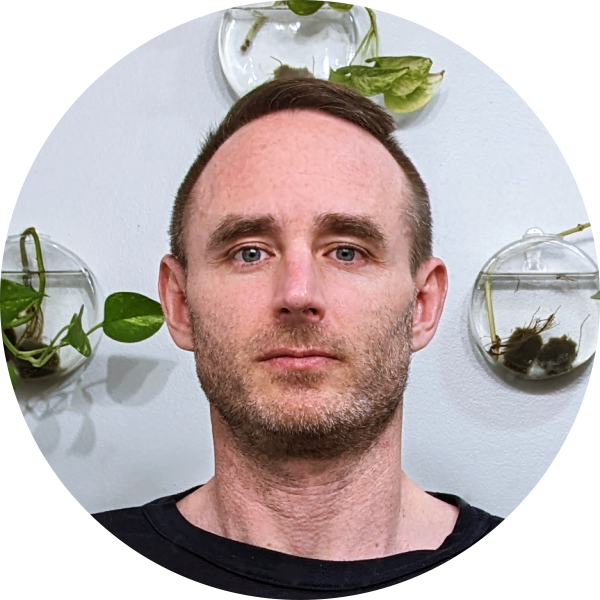
Lee von Kraus












Work Noted In:
Mentor:
Founder: